There’s a particular kind of silence that gets shattered at 3 AM.
You know the one. That sound that doesn’t belong, the one your brain registers before your eyes even open. Glass breaking. A door handle jiggling. Footsteps where footsteps shouldn’t be.
At that moment, the gun you’ve been romanticizing on YouTube doesn’t matter! What matters instead is what you can actually run when your hair looks like a haunted scarecrow, your contacts are still in their case, and your bare foot just found a rogue LEGO in the hallway.
So let’s talk about the three contenders most folks are weighing for this exact scenario, and which one actually pulls its weight when the lights are off and your heart is doing 180.
The Pistol: The “I Can Carry This Anywhere in the House” Champion
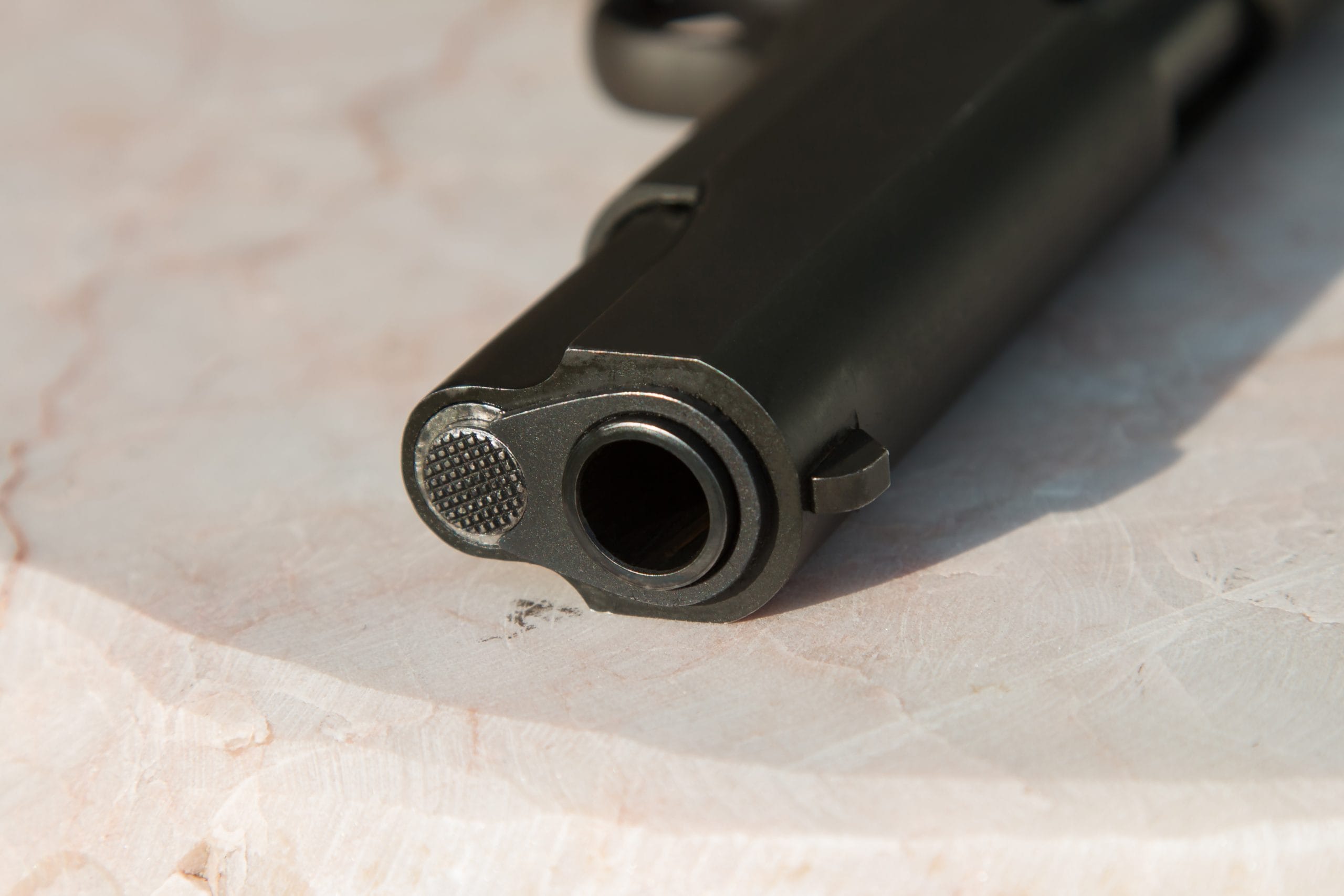
A handgun is the most maneuverable option, full stop.
You can hold a phone in one hand to call 911, open a door, herd kids into a closet, or check a corner without turning yourself into a flagpole. That matters more than people realize until they actually try clearing a hallway in the dark.
Pistols are also easy to stash. A quick-access safe bolted to the nightstand, a biometric lockbox, a holster mounted under the bed frame, the options are endless. You’re not trying to figure out where to lean a four-foot-long object at 3 AM.
Another advantage to a pistol is if you attach a silencer to it to reduce noise levels in the house. You’ll want to load your handgun with subsonic ammunition for this purpose, and subsonic load data can help you to find the optimized loads you need for your suppressor and gun.
Where the Pistol Falls Short
Here’s the honest part. Pistols are the hardest of the three to shoot well. Recoil management, sight alignment, trigger control, all of it gets exponentially harder when adrenaline turns your hands into uncooperative claws. If you haven’t put real time in at the range, your hit probability drops fast.
Pistols also offer the least stopping power of the three. That doesn’t mean they don’t work. Millions of self-defense incidents say they do. But if you’re choosing purely on terminal performance, the handgun is in third place.
If you’re new to pistols and want to figure out which one fits your hand, your budget, and your mission, browsing through some honest gun reviews before you buy beats walking into a shop and pointing at whatever the guy behind the counter is selling that week.
The Shotgun: The Old-School Heavyweight
Ah, the shotgun. The gun your grandpa probably told you was the only thing you needed in the house. He wasn’t entirely wrong. A 12 or 20 gauge loaded with appropriate buckshot is, on a per-trigger-pull basis, the most decisive home defense round on this list. It’s not even particularly close.
A shotgun is also a known quantity. The sound of a pump action racking is, fairly or not, considered one of the most universally understood “leave now” signals in the English-speaking world. Whether you should be relying on that as a deterrent is its own debate, but it’s part of the lore.
If you’re someone who already runs a shotgun for hog hunting or bird work, you’ve got a built-in advantage. You already know how it patterns, how it kicks, and how to keep it fed under pressure. That familiarity is worth more than any spec sheet.
Where the Shotgun Gets Awkward
Length is the issue. A standard 18.5-inch barrel shotgun is still a long gun, and navigating a tight hallway, a stairwell, or a bedroom doorway with one is a learned skill. Beginners tend to muzzle the corner before they see what’s behind it.
Capacity is also limited compared to the AR. Most defensive shotguns hold five to eight rounds, and reloading one under stress is a fine motor skill that goes to pieces when your hands are shaking.
Recoil is real, too. A 12 gauge with full-power buckshot is a stout push. Smaller-statured shooters or anyone with a shoulder that’s seen better days often migrate to 20 gauge, which is a perfectly capable home defense round and significantly more pleasant to run. Don’t let anyone tell you otherwise.
While we’re on the subject of being well-equipped, having the right hunting supplies on hand, lights, slings, ammo storage, generally translates to being better prepared at home, too. Defensive shooting and field shooting share more gear than people think.
The AR-15: The One Everyone Argues About
The best type of rifle for home defense is not a bolt-gun or a precision rifle such as the ones offered from Pristine Precision Rifle Actions. The best rifle for home defense is an AR-15.
The AR-15 is, statistically and ballistically, an extraordinary defensive tool. Low recoil, fast follow-up shots, generous capacity, easy to mount a light and red dot, and surprisingly soft on barrier penetration when loaded with the right defensive ammunition. Yes, you read that correctly. A properly chosen 5.56 round often penetrates fewer interior walls than a 9mm pistol round or buckshot.
For someone who’s invested time in training, the AR is the easiest of the three to shoot well under stress. The longer sight radius, the optic, the manageable recoil, all of it stacks in your favor.
Where the AR Asks More of You
It’s loud. Genuinely, painfully loud indoors without hearing protection. All three options are loud, but the AR is its own category. Plan accordingly with an electronic ear pro staged near your ready position if you go this route.
It’s also still a long gun, with all the maneuverability concerns that brings, though shorter barrel configurations help. And it’s the option most likely to spark a conversation with neighbors, in-laws, or anyone who watches the local news. That shouldn’t drive your decision, but pretending it doesn’t exist is silly.
If you’re going to lean into the AR, putting the work in matters. Dry fire, live fire, low-light drills, the whole deal. Folks serious about improving accuracy tend to treat their rifle like an instrument, not a poster. There’s a difference between owning an AR and being able to run one.
So…Which One Actually Wins?
Honest answer?
The one you’ll actually train with. The one you can access in the dark. The one you can run safely with your kids, your partner, and your dogs all somewhere in the house. The one that fits your home’s layout.
You get the idea. For most people in most homes, a pistol with a weapon-mounted light, stored in a quick-access safe within arm’s reach of the bed, is the best balance of accessibility, maneuverability, and capability. For folks with more square footage, more training time, or specific concerns, the long gun makes more sense.
Whatever you choose, store it properly when it’s not in use. A locked nightstand at night, a safe during the day, and if you like to keep one accessible in your office or living room, a quality gun display stand gets it off the floor and out of curious hands.
The gun in your hand at 3 AM only matters if you’ve practiced with it at 3 PM. Pick the one you’ll actually run, learn it cold, and hope you never need it.